Local relaxation and scale-dependent alignment in compressible, magnetized turbulence

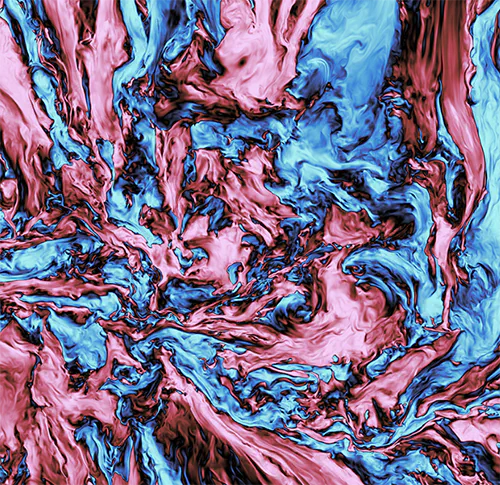 A simulation slice showing local alignment between the velocity and magnetic fields. Visualization: James R. Beattie.
Order within turbulent plasma
Our paper with Amitava Bhattacharjee has been accepted in Physical Review Letters. The updated paper explores how a turbulent plasma organizes itself into locally aligned patches, even while the flow remains turbulent overall.
We compare simulations with and without a mean magnetic field, using grids as large as 10,368³ cells. Below the scale where kinetic and magnetic energies balance, the velocity, magnetic field, vorticity, and electric current show distinct patterns of alignment. The image above reveals the intricate spatial structure of velocity–magnetic alignment.
The revised study connects this local organization to a model for how departures from relaxed states move between scales. It predicts the measured velocity–magnetic and velocity–vorticity alignment exponents, helping explain the geometry of turbulent eddies and when magnetic reconnection may reshape the cascade.