Sparking Dynamic, Relativistic Magnetic Reconnection in a Twisted Flux Tube

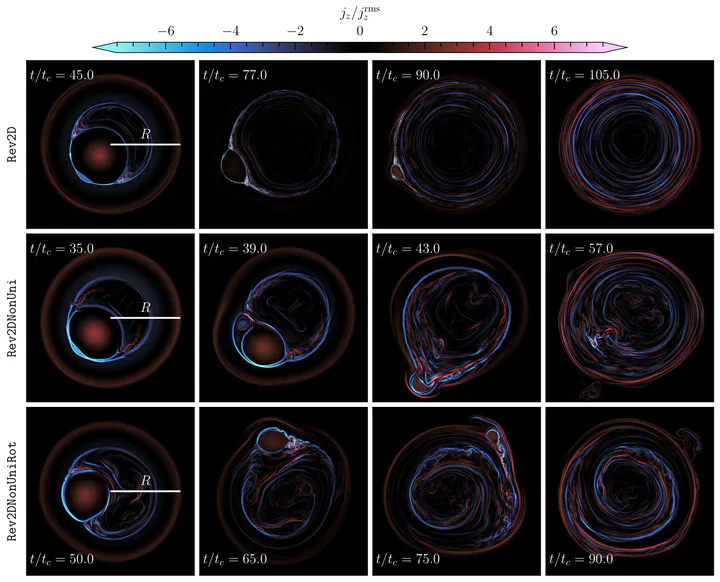 Current density during reconnection. Grehan et al. (2026), Fig. 4, CC BY 4.0.
A small spark in a twisted field
A twisted magnetic field stores energy. How can a small disturbance release it? In our new preprint, led by collaborator and CITA graduate student Michael Grehan, we study this question in a narrow flux tube relevant to neutron-star magnetospheres.
The tube contains opposing twists threaded by a stronger field along its length. A localized perturbation pushes the inner region sideways, forming a thin current sheet where magnetic connections change. Magnetic islands, called plasmoids, emerge from the sheet, while shearing outflows develop Kelvin–Helmholtz instabilities and generate finer currents. Energy release becomes patchy and intermittent.
When the plasma runs short of charges
We compare uniform resistivity with a model that responds to charge starvation, when too few particles are available to carry the required current. This feedback accelerates reconnection. Complementary three-dimensional calculations show limited kink growth with a strong guide field, supporting the planar description in this regime.
The resulting current spikes could contribute to radio-pulse microstructure and magnetar heating. These are possible applications of the model, rather than direct predictions of an observed burst.
Image: Figure 4, Grehan et al. (2026), reproduced unchanged under CC BY 4.0.